
My Review Rating:

4 Out of 5 Stars = Very Good!
Solo ads have been dividing affiliate marketers for years. Some swear by them.
Others have burned through hundreds of dollars without a single sale to show for it. The truth, as usual, lives somewhere in the middle, and Udimi sits right at the center of that debate.
This Udimi review takes an honest, balanced look at the platform from the perspective of someone building a real online business. Not a get-rich-quick scheme. Not a magic traffic button. Just a straightforward look at what Udimi is, how it works, who it’s right for. And, just as importantly, who should wait before spending a single dollar on paid traffic.
Let’s dig in.
What Is Udimi?
Udimi is an online marketplace where buyers purchase email solo ads from independent sellers who have built their own email subscriber lists. The concept is simple: a seller has an audience, a buyer wants exposure to that audience, and Udimi facilitates the transaction safely in between.
Buyers browse seller profiles, select a click package, provide a landing page URL, and the seller sends a dedicated email to their list promoting that offer. Clicks arrive at the buyer’s landing page, and some of those visitors subscribe, engage, or eventually purchase.
Sellers are independent entrepreneurs; often experienced email marketers with lists they’ve built over months or years in specific niches. The niches available on Udimi skew heavily toward online business, make money online (MMO), health, and personal development. If someone is in a different niche, say, B2B software or local services, Udimi may offer very limited relevant sellers.
The platform itself acts as a middleman and protects both parties. Payments are held in escrow until the campaign completes, and Udimi filters out bot traffic automatically, crediting buyers if click quality falls below acceptable thresholds.
How Solo Ads Work: A Step-by-Step Flow
For someone new to the concept, understanding the flow of a solo ad campaign is essential before spending any money. Here’s how the process works on Udimi:
Choose a Seller
↓
Select Number of Clicks
↓
Submit Your Landing Page URL
↓
Seller Emails Their Subscribers
↓
Clicks Arrive at Your Page
↓
Some Visitors Subscribe to Your List
↓
Some Subscribers Eventually Purchase
The key phrase in that last step is eventually. Solo ads are not a direct path to immediate sales. They are a method of driving targeted visitors to a landing page, capturing their email address, and then following up with an automated email sequence that builds trust and promotes an offer over time.
This is where many beginners go wrong. They buy 100 clicks, send traffic directly to an affiliate product page, see zero sales, and declare solo ads a scam. But that’s not how this works. The goal of a solo ad is typically to build the email list first, not to generate instant commissions.
The money, as veteran marketers say, is in the follow-up. A well-structured email sequence does the selling. The solo ad just fills the top of the funnel.
Understanding Filters, Ratings, and Seller Quality
One of Udimi’s strongest features is its rating and filtering system.
Every seller has a public profile showing detailed performance metrics. Reading those metrics carefully is the difference between a productive campaign and a frustrating one.
Key metrics to evaluate before buying:
- Seller Rating – Aggregated score from past buyers
- Repeat Orders – Percentage of buyers who came back, signaling satisfied customers
- Reviews – Written feedback from past buyers
- “Got Sales” Percentage – How often buyers reported generating sales from that seller’s traffic
- Top-Tier Traffic % – Percentage of clicks from Tier 1 countries (US, UK, Canada, Australia)
- Delivery Speed – How quickly the seller fulfills orders
- Response Rate – How reliably the seller communicates
For beginners, the “Got Sales” percentage is particularly revealing. A seller with a 20% “Got Sales” rating means roughly one in five buyers reported generating at least one sale. That’s not a guarantee of results; it depends heavily on the buyer’s landing page, offer, and follow-up, but it’s a useful signal of list quality.
The most common beginner mistake? Sorting by lowest price and clicking buy. Cheaper clicks are almost always cheaper for a reason. A seller charging $0.35 per click and a seller charging $0.75 per click are not offering the same product. The higher-priced seller likely has a more engaged, more responsive list. Always read reviews and check repeat order rates before making a decision.
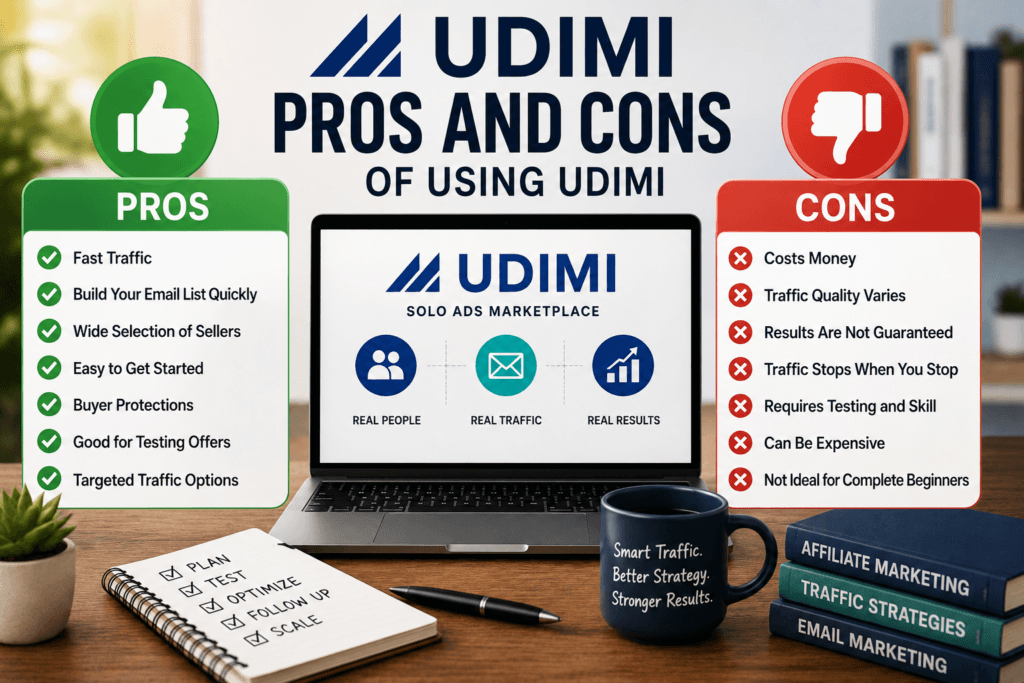
Pros and Cons of Using Udimi
✅ Advantages
- Fast traffic – Unlike SEO or social media, clicks can start arriving within 24–48 hours of placing an order
- No SEO required – Udimi bypasses organic search entirely, making it accessible without technical knowledge
- List-building speed – A well-optimized landing page can capture email subscribers rapidly compared to free methods
- Wide seller selection – Hundreds of sellers across multiple sub-niches with public reviews
- Built-in buyer protections – Escrow payments, bot traffic filtering, and dispute resolution
- Rapid offer testing – Marketers can test different landing pages, headlines, or offers quickly with real traffic
- Transparent marketplace – Sellers are rated publicly, creating accountability
❌ Disadvantages
- Traffic stops when spending stops – There’s no compounding effect; it’s purely transactional
- Results vary significantly by seller – Two sellers at the same price can produce wildly different outcomes
- Can be expensive – A meaningful test often requires $150–$300 minimum, which adds up quickly
- Poor landing pages waste money – If the page doesn’t convert, no amount of good traffic will save the campaign
- Requires consistent testing – One campaign is rarely enough; marketers need to test multiple sellers
- No sales guaranteed – There is no refund for poor conversion; buyers only receive credits for undelivered or filtered clicks
- Niche limitations – Udimi works best in MMO and online business niches; other markets have fewer quality sellers
How Much Does Udimi Cost?
Udimi campaigns are priced per click, and rates vary based on seller quality, niche, and geographic targeting. Here’s a realistic overview:
| Campaign Size | Estimated Clicks | Approximate Cost |
|---|---|---|
| Starter Test | 100 clicks | $40–$80 |
| Mid-Sized Campaign | 300 clicks | $150–$300 |
| Larger Campaign | 500–1,000 clicks | $300–$750+ |
These are rough ranges. Some premium sellers charge $1.00 or more per click. Some budget sellers offer clicks below $0.40. As mentioned earlier, price alone is not a reliable indicator of quality.
There’s also an important mindset shift required here: the cost of a solo ad campaign should be thought of as the cost of data and leads, not the cost of sales. A $200 campaign that generates 80 subscribers and zero immediate sales is not necessarily a failure. If the email sequence is strong and the offer is relevant, those 80 subscribers can generate revenue over weeks or months.
Beyond per-click costs, Udimi offers a free basic account. A “Prime” membership is available for a monthly fee and unlocks additional filtering options and seller data, which is useful for serious marketers running frequent campaigns, but unnecessary for first-time users.
Who Should Use Udimi?
Udimi is a genuinely useful tool, but only for the right person at the right stage of their business.
Udimi works well for:
✓ Email list builders who have a lead magnet, landing page, and autoresponder ready
✓ Affiliate marketers promoting offers in the MMO, health, or personal development niches
✓ Experienced marketers looking to scale a funnel that’s already converting with free traffic
✓ Anyone split-testing landing page headlines, opt-in forms, or lead magnets
Potentially suitable for beginners only after they have:
a) A functional landing page (not just an affiliate link)
b) An email autoresponder with a written follow-up sequence
c) A clear, relevant offer they’re promoting
d) A tracking system to measure opt-in rates and click-through rates
e) Realistic expectations – building a list, not buying overnight commissions
If all five of those boxes are checked, a beginner can learn a lot from their first Udimi campaign, even if it doesn’t produce immediate income.
Who Should Wait Before Using Udimi?
Not everyone is ready for paid traffic. And spending money before the foundation is in place is one of the most common and costly mistakes in affiliate marketing.
Someone should wait if they:
- Have no website or landing page
- Don’t have an email autoresponder set up
- Haven’t written any follow-up emails
- Don’t clearly understand what conversions are or how to track them
- Haven’t identified their niche or target audience
- Expect to recoup their ad spend immediately through direct affiliate sales
- Are still figuring out which offer to promote
Paid traffic amplifies what’s already working. It doesn’t fix what’s broken. Sending 500 clicks to a poorly built landing page or a confusing offer is simply paying to learn that lesson the expensive way.
Building a proper marketing foundation first – a landing page, a lead magnet, an email sequence, and a tested offer – is the single most important step before ever spending money on traffic.
For beginners who haven’t built that foundation yet, the Plug-In Profit Site provides exactly that framework, designed specifically for people starting from scratch.
Common Mistakes to Avoid on Udimi
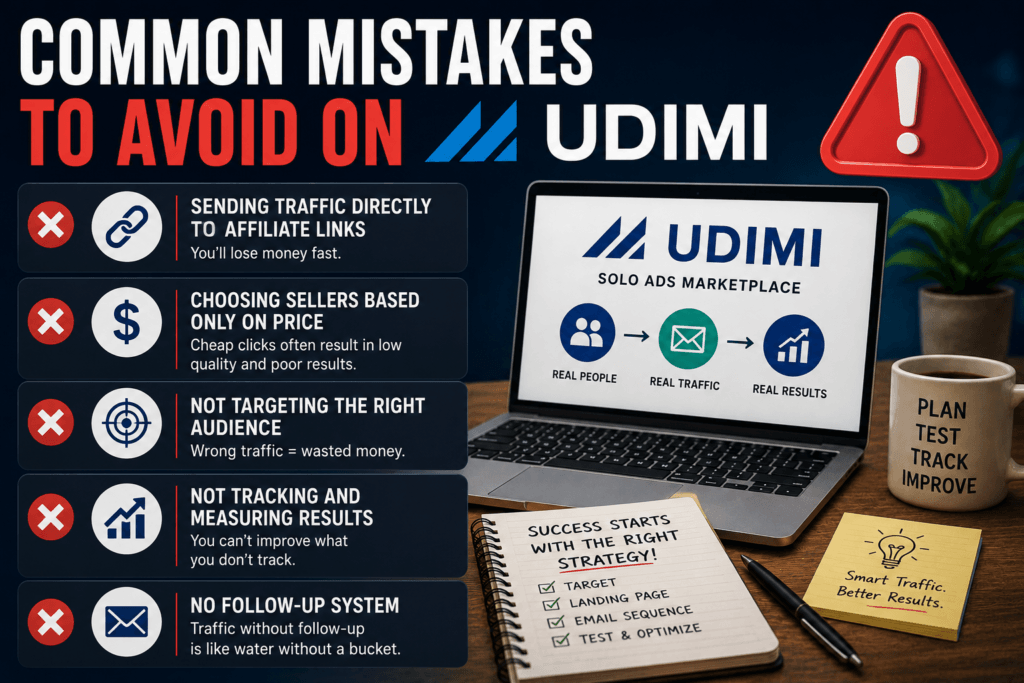
Even marketers who understand solo ads in theory often make avoidable mistakes in practice. Here are the most common ones:
- Sending traffic directly to an affiliate link.
This is the single biggest mistake. Affiliate sales pages are not opt-in pages. When traffic hits an affiliate product page without an opt-in form, the visitor either buys immediately or leaves forever. There’s no follow-up, no relationship, no second chance. Always send traffic to a landing page that captures the email address first.
- Choosing sellers based only on price.
As covered earlier, the cheapest clicks are rarely the best clicks. A new marketer once spent $60 on 200 clicks from a budget seller, received zero opt-ins, and concluded solo ads don’t work. The real issue was that the seller’s list was disengaged and the clicks were low-quality. Reading reviews and checking “Got Sales” data would have pointed toward a better seller.
- Running one campaign and drawing conclusions.
One campaign is not a test. It’s a data point. Meaningful conclusions require testing multiple sellers, ideally with the same landing page, to compare performance. Two sellers can produce a 10% opt-in rate and a 45% opt-in rate for the same page. That gap is entirely about list quality.
- Skipping tracking.
Without tracking – knowing exactly how many visitors opted in, clicked follow-up emails, and made purchases – it’s impossible to improve. Free tools like Google Analytics or affordable tracking solutions can provide the data needed to make smart decisions.
- Ignoring the email sequence.
Many marketers put enormous effort into their landing page and almost none into their follow-up emails. The landing page gets one shot. The email sequence gets 7, 10, or 20 shots. Most revenue from solo ad traffic is generated through the follow-up sequence, not the initial visit.
Udimi vs. Free Traffic Methods
Udimi and free traffic strategies aren’t competitors; they’re complementary tools. Understanding the difference helps marketers use each at the right time.
| Feature | Udimi (Paid Solo Ads) | Free Traffic Methods |
|---|---|---|
| Speed | Immediate visitors | Slow growth |
| Cost | Costs money per click | Mostly time investment |
| Testing | Fast offer and page testing | Long iteration cycles |
| Sustainability | Stops when spending stops | Can compound over time |
| Scalability | Scale quickly with budget | Slower to scale |
| Learning curve | Moderate (requires funnel setup) | Varies by method |
Many successful affiliate marketers use both approaches strategically. Free traffic – through content marketing, SEO, YouTube, or platforms like LeadsLeap – builds a compounding asset over time. Paid traffic through Udimi accelerates list growth during campaigns and provides fast data for funnel optimization.
Using free traffic to validate an offer, then scaling it with paid traffic, is a lower-risk approach than jumping straight into paid ads with an untested funnel.
Understanding the Real Risk of Paid Traffic
Every dollar spent on paid traffic is a dollar at risk. That’s not a warning to scare anyone away; it’s just an honest framing that sets realistic expectations.
The goal of buying a solo ad is not to purchase sales. The goal is to purchase leads, data, learning, and experience. A marketer who spends $200 on a Udimi campaign, generates 90 subscribers, and learns that their landing page converts at 18% has bought something genuinely valuable, even if no immediate commissions appeared.
That data tells them their opt-in rate is decent, their offer is at least somewhat relevant to the audience, and the follow-up sequence now needs attention. That’s an actionable insight worth more than a single commission. For a deeper look at why organic trust-building matters alongside paid traffic, see Why Trust Matters More Than Traffic in Affiliate Marketing.
Paid traffic requires a budget one can afford to lose while learning. Anyone considering Udimi should only spend money they’ve mentally earmarked as a marketing education investment, not money they’re counting on getting back.
FAQ: Common Questions About Udimi
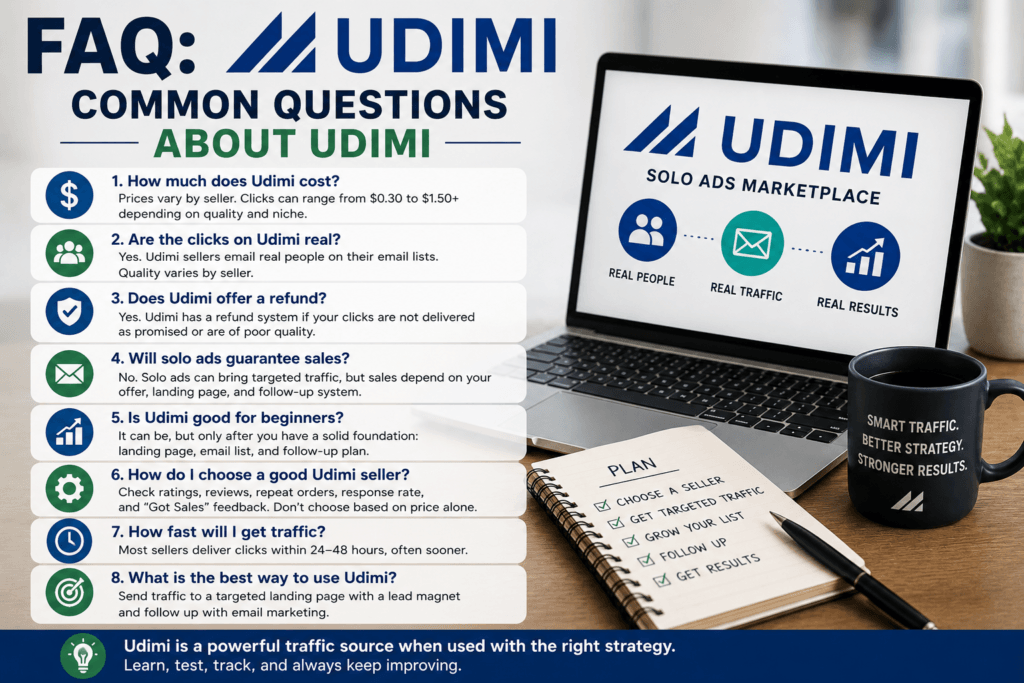
Q: How much does it cost to start on Udimi?
A beginner can start with as little as $40–$50 for a 100-click package. However, a more meaningful test typically requires $150–$300 across a few different sellers. A single $40 campaign rarely provides enough data to draw useful conclusions.
Q: Is Udimi traffic real or bot traffic?
Udimi filters out bot traffic automatically and credits buyers for any low-quality clicks detected. However, “real” traffic doesn’t automatically mean “qualified” traffic. The audience quality depends entirely on the seller’s list and how well it matches the buyer’s offer.
Q: Can beginners use Udimi?
Beginners can use Udimi, but they should only do so after setting up a landing page, an autoresponder, and a follow-up email sequence. Without those elements in place, paid traffic will almost certainly produce disappointing results regardless of the platform. Check out Affiliate Marketing for Beginners for a solid starting point.
Q: Does Udimi offer refunds?
Udimi does not offer refunds for poor conversion rates, sellers fulfill the agreed number of clicks, and that’s the service being purchased. However, if a seller fails to deliver the purchased clicks within the agreed timeframe, Udimi provides buyer protections and can issue credits.
Q: What niche works best on Udimi?
The make money online (MMO), internet marketing, and home business niches have the largest seller pools on Udimi. Health, personal development, and online education niches also have options. More specific or local niches tend to have fewer quality sellers available.
Q: How do I know which seller to choose?
Filter by niche, check the “Got Sales” percentage, read at least 10-15 recent reviews, look at the repeat order rate, and verify that the top-tier traffic percentage is above 70% if targeting English-speaking audiences. Avoid any seller with fewer than 20 reviews or a response rate below 85%.
Q: How long does it take to receive clicks after ordering?
Most sellers deliver within 24-72 hours. Some offer express delivery. Delivery speed is listed on every seller’s profile, and buyers can filter for faster options if timing matters.
Q: Is Udimi worth it compared to other traffic methods?
Udimi is worth it as part of a broader traffic strategy, not as a standalone solution. It delivers fast, targeted traffic in specific niches. But it works best when combined with free traffic methods that build long-term organic reach. For a comparison with another popular platform, see the LeadsLeap Review for Affiliate Marketers.
The Verdict: Udimi Review Summary
This Udimi review lands at a solid 4 out of 5 stars. That rating reflects both genuine respect for the platform and honest acknowledgment of its limitations.
Udimi is a legitimate, well-structured marketplace. The buyer protections are real. The rating system creates meaningful accountability. The ability to test offers quickly and build an email list faster than through organic methods alone is genuinely valuable for the right marketer at the right stage.
But Udimi is not a shortcut. It is not a guaranteed income source. And it is not the first step for someone who’s just discovered affiliate marketing last week. Solo ads work when they’re the final piece in a functioning system, not the first piece of a system that doesn’t exist yet.
For affiliate marketers who already have a landing page, an autoresponder, a written email sequence, and a relevant offer, Udimi is absolutely worth testing. For those still building that foundation, the smarter move is to build first and buy traffic later.
Consider reading:
Ready to Buy Traffic the Smart Way?
Before investing in paid traffic like Udimi, make sure you have a solid foundation: a landing page, an email follow-up system, and an offer you’re confident promoting.
If you’re still building that foundation, start with the Plug-In Profit Site. It provides beginners with the training and tools needed before spending money on advertising. Build it right first. Then drive traffic.
Disclosure: This article may contain affiliate links. If you click and purchase, this site may earn a commission at no additional cost to you. All opinions are honest and based on a real evaluation of the platform.