
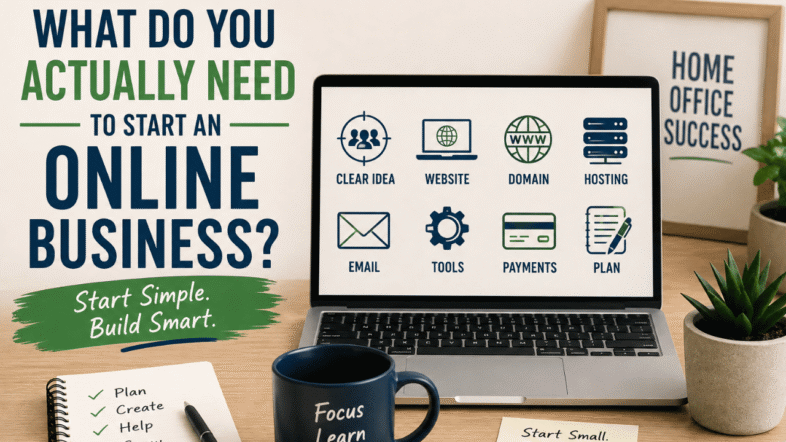
If you’re thinking about starting an online business, it doesn’t take long before the list of things you supposedly need starts getting ridiculous.
You need a website. A premium theme. Email marketing software. An SEO tool. A logo. Social media accounts. Business software. An LLC. A course. A sales funnel. An AI subscription. Maybe some advertising.
Keep going, and you can spend a small fortune preparing to start a business that hasn’t earned a dollar.
Most beginners don’t need nearly that much.
In fact, one of the smartest things you can do is separate what you actually need to start from what might become useful later.
Here’s what I believe really matters.
Start With a Person and a Problem
Before choosing software or building a website, you need to know who you’re trying to help.
You don’t have to identify the perfect niche or create an elaborate customer profile. You just need a reasonable idea of the person you’re trying to reach and what you can help that person accomplish.
- Maybe you know how to repair lawn equipment and want to help homeowners handle simple repairs themselves.
- Maybe you’ve spent years managing people and want to create resources for small-business owners.
- Maybe you’re retired and have learned practical ways to stretch a fixed income.
The business starts with the connection between something you can provide and something another person needs.
Everything else gets built around that.
You Need Something Useful to Offer
An online business needs to provide value, but that doesn’t mean you need a finished product before you begin.
Useful information can be your starting point.
You might publish articles that answer questions people are searching for. Later, you could recommend relevant products as an affiliate, sell your own digital resources, offer a service, generate advertising revenue, or develop another income stream.
A service business might work differently. If you already possess a useful skill, you may be able to offer that skill directly to customers without publishing dozens of articles first.
The business model can vary. The requirement doesn’t: You have to give people a reason to pay attention to you.
A Website Is Usually Worth Having
Technically, you can operate certain online businesses without your own website. I still think owning one makes sense for many people.
Social media platforms, marketplaces, and other third-party services can be useful, but you’re building on someone else’s property. Rules change. Algorithms change. Accounts can disappear. Fees can increase.
Your website gives your business a home.
Fortunately, it doesn’t need to be elaborate.
A clean website explaining what you do, who you help, and where visitors should begin is enough to get started. Add useful content and additional features as you actually need them.
Don’t build 30 empty pages because you think a business website is supposed to look big. Five useful pages beat 30 useless ones.
You’ll Need a Domain and Hosting
If you’re creating your own website, two of the legitimate expenses are usually a domain name and web hosting.
Your domain is your business’s address online. Your hosting provides the server space where the website operates.
Neither needs to be expensive when you’re starting.
Choose a domain that’s reasonably short, memorable, easy to spell, and appropriate for your business. Then choose basic, dependable hosting that meets your current needs.
TIP: Today, most website hosting providers offer a Free Domain Name when you purchase a website hosting account.
You don’t need hosting designed for massive traffic when nobody knows your website exists yet. If the website eventually outgrows your hosting plan, that’s a good problem. Upgrade then.
If you’ve decided that a website makes sense for your business, the next decision is what to call it. Our guide to choosing a domain name for your online business explains what to look for, what to avoid, and why simple is usually better.
Use the Computer You Already Own
Starting an online business does not automatically require a new computer. If your existing laptop or desktop can comfortably handle your work, keep using it.
The same principle applies to your home office. You don’t need a $1,000 desk, three monitors, a professional microphone, studio lighting, an expensive office chair, and a wall full of motivational artwork before you can call yourself a business owner.
Buy equipment because you need it, not because it makes starting the business feel more official. There’s nothing wrong with improving your workspace later. Just give the business a chance to help pay for it.
Free Software Is Often Good Enough
This is one of the easiest places for new online business owners to overspend.
Nearly every problem seems to have a software subscription attached to it.
Some paid tools are excellent. Some may eventually save you enough time or make you enough money to easily justify their cost.
That doesn’t mean you need them today.
Free versions of writing tools, graphics programs, analytics services, keyword tools, office software, website plugins, and other resources may be perfectly adequate when you’re starting.
Use them until they stop doing what you need.
Then you’ll know why you’re upgrading instead of guessing that you should.
You don’t need to buy everything at once. If keeping startup costs under control is important to you, read how to start an online business without spending a fortune for a practical approach to building as the business earns its upgrades.
You Need a Way to Reach People
This is where a lot of beginning online businesses run into trouble.
They build something and wait.
Unfortunately, putting a website on the internet doesn’t mean people will automatically find it.
You’ll eventually need a way to attract visitors or customers.
Search engines might be your primary source. Perhaps your audience is easier to reach through YouTube, Pinterest, social media, online communities, referrals, networking, or email.
Paid advertising is another possibility, but it isn’t something I’d recommend rushing into before you understand your audience and what you’re offering.
You also don’t need to be everywhere.
I’d rather learn one traffic source well than poorly manage six of them.
You Need a Way to Get Paid Eventually
Notice the word eventually.
If you’re selling a product or service from the beginning, then yes, you’ll need a reliable way for customers to pay you.
But if you’re initially building an informational website and haven’t created anything to sell yet, setting up an elaborate ecommerce system isn’t your first priority. Don’t solve problems you don’t have.
When you’re ready to sell, choose a payment method appropriate for what you’re selling and make purchasing straightforward and secure. Until then, spend your time building something worth paying for.
Keep Track of the Money From Day One
Even if your first month’s business income is zero, start keeping records.
Record your legitimate business expenses. Save receipts. Track subscriptions. Record revenue when it arrives.
You don’t necessarily need sophisticated accounting software for a tiny business.
You do need organization.
It’s much easier to develop that habit when you have ten transactions than when you suddenly have hundreds.
Learn What Your Business Legally Requires
There’s no universal list of legal requirements that applies to every online business.
Requirements can vary by location, business activity, products or services, and business structure.
That’s why I wouldn’t automatically purchase an LLC package, expensive legal subscription, insurance policy, or other service simply because someone online says every business owner needs it.
Find out what actually applies to your situation.
Use your official local government sources when researching registration, licensing, and tax requirements, and get qualified professional advice when your circumstances require it.
Take legal responsibilities seriously. Just don’t turn every possible future liability into an expense before you’ve determined whether it actually applies to you.
What You Don’t Need Is Just as Important
Perhaps the biggest advantage a new online business has is that it can remain small.
- You don’t have employees.
- You don’t have corporate offices.
- You probably don’t have enormous overhead.
Don’t voluntarily create it.
You probably don’t need premium versions of every piece of software you encounter. You don’t need expensive branding. You don’t need a huge advertising budget. You don’t need every social network. You don’t need ten business courses.
And you definitely don’t need to buy every product promising to make starting a business easier.
Every recurring expense should eventually have to justify its existence.
Twenty dollars here and $39 there may not seem significant until your supposedly inexpensive online business has accumulated $300 in monthly subscriptions.
Ask One Question Before Spending Money
Before purchasing something for your new business, ask:
What problem am I solving by buying this?
That’s a remarkably effective filter.
If the answer is specific, good.
If the answer is something like, “I think I’ll probably need it eventually,” wait.
Eventually isn’t today.
When the problem actually appears, the product will still be available.
You may also discover that you never needed it at all.
What You Really Need to Get Started
When you strip away all the marketing and complexity surrounding online business, the essentials are pretty basic.
- You need to know who you want to help.
- You need something useful to offer them.
- You need a practical way to reach them.
- You need somewhere to conduct the business.
And when the time comes, you need a way to turn the value you’re providing into revenue. The rest can be built as you go. Your first online business doesn’t need to look like an established company. It needs to start operating.
Create something useful. Publish it. See how people respond. Learn from what happens. Improve it.
Then decide what you need next.
That’s how you keep a small online business small enough to afford, and give it enough time to become something bigger.