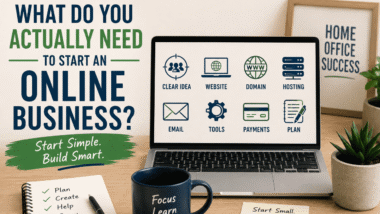

Starting an online business can get expensive surprisingly fast.
Buy a premium website theme. Subscribe to an email service. Purchase an AI tool. Sign up for keyword research software. Get a logo designed. Buy a course. Upgrade your hosting. Add another plugin.
Before you’ve made your first dollar, you can easily find yourself paying hundreds of dollars, sometimes every month, for a business that hasn’t proven it can make money. There is another way.
You can start an online business with a relatively small investment, use simple tools, learn as you go, and allow the business itself to tell you where additional spending makes sense.
That’s the approach I believe makes the most sense for most beginners.
Don’t Spend $500 Trying to Make Your First $100
This is one of the simplest rules I can give someone starting an online business:
Don’t spend $500 trying to make your first $100.
It sounds obvious, but it’s surprisingly easy to do.
Online business owners are constantly being shown products that promise to make building a business easier, faster, more professional, or more profitable. Some of those products are genuinely useful.
The problem is timing. A $50-per-month tool that saves an established business owner five hours every month might be an excellent investment. The same tool could be completely unnecessary for someone who doesn’t have a website visitor yet.
Before buying something for your business, ask yourself:
What problem does this solve for me right now?
If you can’t clearly answer that question, you probably don’t need it yet.
Start With the Smallest Version of the Business That Can Work
You don’t need to build the company you hope to have three years from now.
Build the business you need today.
Suppose you want to start a website that teaches beginners how to grow vegetables.
You could spend weeks developing an elaborate website with dozens of categories, premium graphics, expensive marketing software, social media automation, an online store, a membership area, and an email marketing system.
Or you could start with a domain, basic hosting, a clean website, and several genuinely useful articles.
The second business isn’t as impressive. But it’s actually operating. Someone can find it. Someone can read it. Someone can benefit from it. Most importantly, you can begin learning whether people are interested in what you’re creating. That information is worth far more than having the perfect website on launch day.
Choose One Audience and One Problem
One of the easiest ways to make an online business unnecessarily complicated is trying to serve everyone.
Instead, start by answering two questions:
Who am I trying to help?
What am I helping them accomplish?
You don’t need a sophisticated business plan to answer them. Maybe you want to help retirees learn basic computer skills. Perhaps you know a lot about maintaining older vehicles and want to help people avoid unnecessary repair expenses. Maybe you’ve spent years gardening in small spaces and can help apartment dwellers grow food on patios and balconies. The possibilities are almost endless.
The important part is connecting something you know, enjoy, or are willing to learn with something other people genuinely want help with. That’s the beginning of a business.
Pick a Simple Business Model
There are many legitimate ways to make money online.
You can sell digital products, provide services, earn advertising revenue, recommend products through affiliate marketing, create courses, sell memberships, generate leads, or combine several approaches.
Beginners sometimes make the mistake of trying to do all of them at once.
Don’t.
Choose one primary model and learn how it works.
For example, someone building an informational website might begin by publishing helpful content and eventually recommend relevant products through affiliate links.
Someone with a marketable skill might start with a simple service business instead.
Someone who has developed useful templates, worksheets, guides, or other resources might sell digital downloads.
None of these approaches requires building a complicated business from the beginning.
Start with the simplest model that fits what you’re trying to accomplish.
Understand What You Actually Need to Buy
There are some legitimate startup expenses.
If you’re building your own website, you’ll probably need a domain name and web hosting. Depending on what you’re building, you may eventually need specialized software or services.
But separate necessary expenses from nice-to-have expenses.
A domain for your business may be necessary. A $200 premium theme probably isn’t.
Reliable hosting may be necessary. Five different paid SEO tools probably aren’t.
A payment processor may be necessary once you’re selling something. An expensive sales funnel platform may not be.
Whenever possible, begin with free or inexpensive versions of tools. Upgrade when you encounter a real limitation rather than an imagined future limitation. That’s an important distinction.
Your domain name is one of the few things worth choosing carefully from the beginning, but that doesn’t mean it needs to be expensive. Here’s how to choose a domain name for your online business without overcomplicating the decision.
Use Free Tools Until They Stop Being Good Enough
Free doesn’t automatically mean inferior.
Many excellent online tools offer free versions that are more than adequate for a beginning business.
The key is not becoming obsessed with finding the perfect collection of tools.
You need enough technology to do the work.
That’s it.
If a free tool handles everything you currently need, keep using it.
When your business grows to the point where the free version is costing you time, limiting your capabilities, or preventing you from making money, then an upgrade may make sense.
At that point, you’re spending money to solve a demonstrated problem.
That’s very different from spending money because you think you might need something someday.
LeadsLeap is an All-In-One Internet Marketing Platform with both a FREE ACCOUNT & a PRO ACCOUNT. Check it out and understand the differences between the two accounts, then sign up for the free account to check things out. Just a note here…If you decide to upgrade to get all the features and you do so within the First 24 Hours of creating your Free Account, your monthly price will be reduced from $27 per month down to $23 per month and SAVE YOU $48 in your first year!
Don’t Confuse Learning With Building
Research is useful. Courses can be useful. Books, videos, podcasts, tutorials, and business websites can all teach you something.
But there’s a trap here. You can spend months learning how to start an online business without actually starting one.
Eventually, you have to build something.
- Publish the website.
- Write the article.
- Create the product.
- Offer the service.
- Send the email.
Put something in front of real people and see what happens. You’ll probably make mistakes. That’s fine.
Some of the most valuable information you’ll get about your business will come from those mistakes. You can’t learn everything beforehand.
Don’t Expect Your First Idea to Be Perfect
Your original business idea may change. Your audience may change. The way you make money may change. Even the products or services you eventually offer may be very different from what you originally imagined.
That’s another reason not to spend heavily in the beginning. Flexibility has value.
If you’ve invested thousands of dollars into a particular idea, technology platform, or business model, it becomes psychologically and financially harder to change direction.
When you start lean, you can adjust.
- If readers respond strongly to one subject, create more content about it.
- If nobody seems interested in another subject, reconsider it.
- If a product sells, improve it.
- If something doesn’t work, figure out why before spending more money trying to force it to work.
Your early business should be an experiment, not a monument.
Focus on Helping Before Monetizing Everything
It’s natural to think about money when you’re starting a business. It is a business, after all.
But focusing exclusively on monetization can cause beginners to overlook the reason someone would visit their website, subscribe to their email list, buy their product, or hire them in the first place. You have to be useful.
Before asking how you can make money from a visitor, ask:
How can I help this person?
- Answer their question.
- Solve a problem.
- Explain something clearly.
- Save them time.
- Help them avoid a mistake.
- Point them toward a useful resource.
Businesses become easier to understand when you think about them this way. People don’t exist to support your business. Your business exists because it provides something useful to people.
Let Revenue Earn the Upgrades
Here’s another principle worth considering:
Let the business earn its upgrades.
Suppose your website starts making $50 a month. Instead of immediately spending that money, you might allow it to accumulate toward something that genuinely improves the business.
- Maybe better hosting eventually becomes necessary.
- Perhaps a paid email service becomes worthwhile because your subscriber list has grown.
- Maybe a particular software tool can automate something you’re now spending hours doing manually.
Now the purchase has a reason behind it. Even better, the business is helping pay for it. This creates a very different relationship with business expenses. Instead of constantly feeding personal money into an unproven idea, you’re gradually building something that begins supporting itself.
Your First Goal Isn’t a Million Dollars
Big income goals make great advertising. They aren’t always great starting goals. If you’ve never earned money online, your first goal doesn’t need to be replacing your salary, earning six figures, or creating passive income.
- Make your first dollar.
- Then make $10.
- Then $100.
- Then figure out how to do it again.
Those early dollars teach you something important: someone was willing to exchange their money for something your business provided. That’s proof. Once you have proof, you can start improving the process.
- Where did the customer come from?
- What did they buy?
- Why did they buy it?
- Can you attract another customer?
- Can you improve the product?
- Can you increase traffic?
- Can you repeat what worked?
Those are useful business questions.
They’re much more useful than asking how you’ll make $100,000 before you’ve made $100.
Keep Your Business Simple Enough to Continue
A complicated business is difficult to maintain. A simple business gives you room to learn.
You don’t need every social network. You don’t need every marketing strategy.
You don’t need every software platform. And you certainly don’t need every shiny new tool someone tries to sell you.
You need an idea, people you can help, a way to reach them, something useful to offer, and enough patience to learn what works.
Build that first. Everything else can come later.
Start Small and Let the Business Grow
There is nothing wrong with wanting to build a successful online business. Think big if that’s where you eventually want to go. Just don’t assume you have to start big.
- Start with what you can reasonably afford.
- Use what you already have whenever possible.
- Spend money when there’s a clear reason to spend it.
- Create something useful.
- Put it in front of people.
- Pay attention to what happens.
Then make the next decision based on what you’ve learned. You don’t need to build the finished version of your business on Day One.
Start small. Spend carefully. Learn by doing. Help people. And let the business earn its upgrades.
That’s a much more practical way to build an online business.
One of the easiest ways to overspend is buying things before you know whether you actually need them. Before opening your wallet, take a look at what you actually need to start an online business and separate the essentials from the things that can wait.